
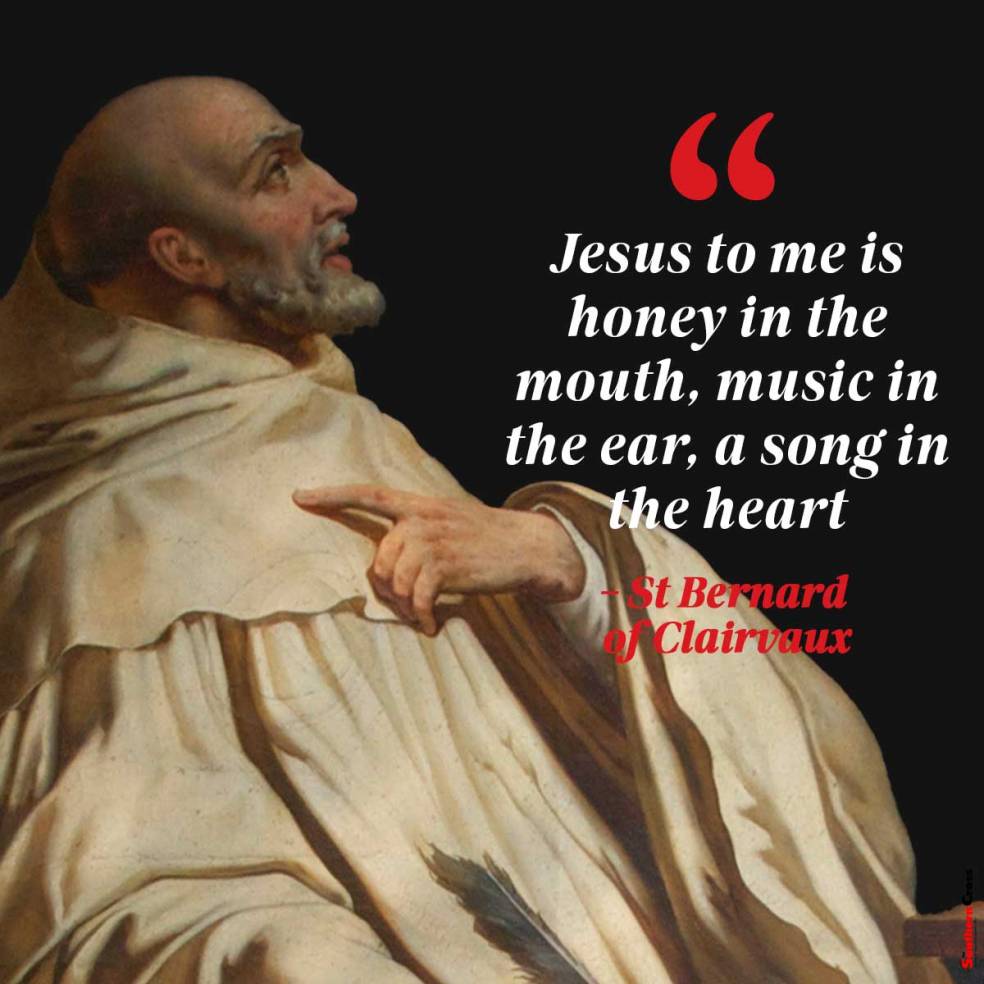
Bob pointed out this meditation to me. I missed reading it on the day it actually posted, the feast day of Bernard of Clairvaux, August 20. Bernard was a Cistercian monk.
Bernard of Clairvaux died 1153
Writing about the importance of meditation, Bernard said that ‘our meditations on the Word who is the Bridegroom, on his glory, his elegance, power and majesty, become in a sense his way of speaking to us. And not only that, but when with eager minds we examine his rulings, the decrees from his own mouth; when we meditate on his law day and night, let us be assured that the Bridegroom is present, and that he speaks his message of happiness to us lest our trials should prove more than we can bear.’**
Sometimes, I approach the Bible in a utilitarian manner. I want to skim through it quickly to find something helpful which I can use, but Bernard reminds me that the Bible is primarily given for meditation and conversation with God, rather than information about him. In Lectio Divina , I read slowly, prayerfully, and with imagination as a conversation-starter with the Lord who has a ‘message of happiness’ for me today..
Do I study the Bible or pray the Bible? Do I read the scriptures, or am I read by the scriptures? Do I attempt to master them, or do I allow them to master me? How expectant am I as I open God’s word today?
*** Bernard of Clairvaux, Intimacy in Prayer: Wisdom from Bernard of Clairvaux (Pauline Books and Media: Kindle Edition).
Bob focused on the question “Do I study the Bible or pray the Bible?” How about you?
Is your Bible time for ‘finding something helpful you can use,’ or allowing conversation with God? Do you even read the scriptures or just occupy your meditation time with devotionals from other people.
When you read the Bible do you turn what you read into prayer? “Do I study the Bible or pray the Bible?” That is a leap from just doing a daily reading or covering a certain number of pages or chapters. Study , prayer, conversation and of course, yielding to the Word of God.
I do all and none of the above. I desire for every time of reading to be prayer time and conversation with God. I do not always succeed. Perhaps we can change our time for devotions into one or more of the actions Bernard calls us to try.
Be expectant as you open God’s word today!
























 Treasures in Plain Sight, A Christian Blog