We have experienced sunrise and sunset at different places in America. It is always so sweet to experience this in a crowd when the crowd breaks out in spontaneous applause at the grandeur of God’s creation.
At times, if we are paying attention, we experience similar things when we are alone. Then we celebrate as the audience of one, celebrating the One who did the creating. Thus, the following poem.
The black cloud perfect backdrop
As sun clears the trees in east
Lighting up treetop to west
Blazing red, swirling gold
Under layer of green
A momentary glimpse of autumn
Grandeur rarely seen
Marvel of God’s handiwork
How was that even possible
That I looked up
Just then to see it?
Camera could not catch it properly
Totally gone now
Just gray rainy day
Orang-ish maple
No big deal
A few chirping birds
Patter of drops on fallen leaves
Applause of the crowd fading
Night time and the Unresolved
Come marching to my bedroom
Tramping through my head
Hurling accusations
Quoting words once said
Reason takes a low profile
While logic flees the scene
Where is the solution
For circumstances now turned mean

Never, shoulds, and woulds
Paint dismal, hopeless scenes
Understanding vanishes
Deep each insult bleeds.

Forgiveness is the answer
That makes the war to cease.
Let it go.    Let go.    Release.
Present moment calls to me
Be NowHere in God's sweet peace

A song can be resung
The past can't be undone
But pouring in forgiveness
The fall-out is made numb

Come to here and now
Feast on today's plenty
In gratitude for all
Dare to now drink deeply
From streams of joy and love

We are granted
Only to
"Live our lives by moments"
Aren't we now
Yes these days I am wrestling with a different sort of Unresolved. The truth of moment by moment living still holds the same truth!
One night I awoke and tried to pray Saint Patrick’s breastplate. After years of knowing and praying it, and reciting it I struggled to remember the words. Here is one version of that prayer.
I arise today through a mighty
strength, the invocation of the Trinity,
through belief in the Threeness,
through confession of the Oneness
towards the Creator.

Christ with me, Christ before me,
Christ behind me,
Christ above me,
Christ on my right, Christ on my left,
Christ where I lie, Christ where I sit,
Christ where I arise,
Christ in the heart of every
person who thinks of me,
Christ in the mouth of every
person who speaks of me,
Christ in every eye that sees me,
Christ in every ear that hears me.
I arise today through a mighty strength,
the invocation of the Trinity...
Whatever happens to be going on in your mind in the middle of the night, I pray you can rest well!
In peace I will lie down and sleep, for you alone, Lord, make me dwell in safety. Psalm 4:8 NIV
After I got first booklet of writing finished I started on poetry booklet. Then I remembered I had not posted any poetry lately. Here is one I really like.
During a church discussion this theme arose without the poem below being read. Bob and I had not yet watched the movie in reference.
One woman mentioned how the movie Moana in 2016 was a guide to her when in a distressful situation, again I was convicted with the certainty that God will use anything to help and guide us. I spoke of the power of Radical Acceptance, a book by a Buddhist psychologist. When I read portions of the book later in the week and this poem, the pieces fell into place.
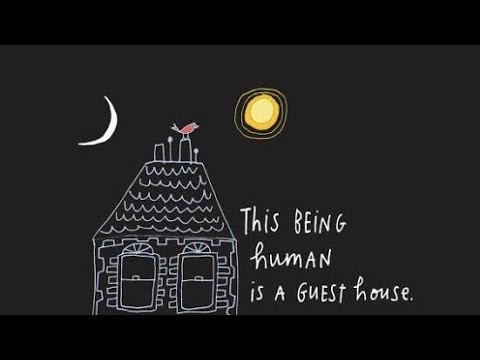
This being human is a guest house. Every morning a new arrival.
A joy, a depression, a meanness, some momentary awareness comes As an unexpected visitor.
Welcome and entertain them all! Even if they’re a crowd of sorrows, who violently sweep your house empty of its furniture, still treat each guest honorably. He may be clearing you out for some new delight.
The dark thought, the shame, the malice, meet them at the door laughing, and invite them in.
Be grateful for whoever comes, because each has been sent as a guide from beyond.
Radical acceptance, can mean entertaining unexpected visitors. Rumi says I am to meet them at the door laughing and invite them in. Things happen to all of us that are unforeseen and can knock us out of our orbit. Do we resist like a stubborn donkey? or yield to the reality of what is and move forward? I cannot say I am able to meet the unexpected at the door and laughing, let them in. But I will learn to with God’s help!
At this website https://fivefortheroad.com/lessons-learned-disneys-moana/She writes the theme of Moana is self discovery and finding your way. She goes on to say family is so important, it’s okay to fail, follow your heart, and be brave.
I would add that whoever or whatever shows up at your door, do as Rumi says and entertain them all! Find your way through any upheaval with the help of the Lord. He is a Good Shepherd and knows every situation before we do, and He is not surprised or taken aback by anything.
Unlike me, I have an unruffled Father!
“In returning and rest I am saved, in quietness and trust will be my strength.” Isaiah 30:15a adapted. Keep still.
Remember the ring above worn by Jonathan Roumie? It so fits with this post!
I thought of the quote below recently when I attended a Zoom book discussion of The Book of Joy. I was very late but did not want to miss the group entirely. I could not recall the poem at the time so I looked it up later. I guess the framed version I used to have was edited to the calligrapher’s liking, because I do not remember anything about a cloud of smoke.
Life should not be a journey to the grave with the intention of arriving safely in a pretty and well preserved body, but rather to skid in broadside in a cloud of smoke, thoroughly used up, totally worn out, and loudly proclaiming “Wow! What a Ride!” ― Hunter S. Thompson, The Proud Highway: Saga of a Desperate Southern Gentleman, 1955-1967
Rather I think of it like I will skid into heaven with a mouthful of chocolate, used up … etc. I might even be late arriving!
Our discussion that night was on chapter about the Illness and Fear of Death. Not a topic most of us enjoy. I once heard. “Change is inevitable. Come to accept it.” I do not know a single human who actually likes change, do you? I wrote about this once before here https://wordpress.com/post/treasures-in-plain-sight.org/153
Impermanence can also be a comfort! I am promised a new body after my death. That will be a relief!! Things will not always remain the same and that is great news regarding the things I absolutely cannot stand.
How about you? As you practice holding all things loosely can you rejoice in the impermanence of life? What might you loosen your grip on? What topic plagues you with negative thinking? Perhaps you could remind yourself that it will not ALWAYS be like this!
When my children were growing up, especially when they were in high school I was sorrowful. Many people asked, “Can’t you be excited about who they will become? What their future holds?” What I had a difficult time explaining was that I so enjoyed being a mother and knowing they were about to fledge from our nest made me sorrowful. No, they hardly need a mother these days. I don’t think they will not really miss me until I leave this earth. The impermanence of life hit me hard in those days.
Archbishop Desmond Tutu speaking in the Book of Joy spoke much about death.
“Because God is God, because God is infinite, because none of us who are creatures will ever fathom the infinitude that is God, heaven is going to be forever a place of new discovery.” The author, Douglas Abrams, goes on to say, Perhaps death and the fear of death is truly the greatest challenge to joy. Well, when we are dead, it does not really matter, but it is the of its approaching, of the suffering that often precedes it, and ultimately the fear of the oblivion and the loss of our person hood that frighten us. Many psychologists say the fear of death lies behind all other fears, and many historians of religion argue that religion arose to try to solve the mystery of death. Modern life keeps that fear at bay, as we don’t interact with the very old or the very sick, and illness, frailty, and death get tucked away behind institutional walls from our everyday lives.
Death is part of our life. Fact. I always opine that none of us are getting out of here alive, unless Jesus comes before we die. And even in living, we are exhorted to die to self! The Dalai Lama pointed out that “the Buddha’s last teaching at the time of his death ends with the truth of impermanence, reminding us how it is the nature of all things that come into existence to have an end. The Buddha said nothing lasts.”
“Everything is in a constant state of change – nothing remains static, and nothing remains permanent,” he reminded them. “What is important to remember is that sooner or later death to comes and to make our life meaningful while we’re alive.” Another contributor to the book, Jinpa, mentioned,”The true measure of spiritual development is how one confronts one’s won mortality. The best way is when one is able to approach death with joy; the next best way is without fear; third best way is at least not to have regrets.”
Guess we each have work to do as we review those ways, checking our own heart and moving towards our inevitable end! May this season as winter approaches, find you ready to perform some of that important self examination. Blessing, Molly D.
There is no fear in love. But perfect love drives out fear, because fear has to do with punishment. The one who fears is not made perfect in love. 1 John 4:18 NIV
So do not fear, for I am with you; do not be dismayed, for I am your God. I will strengthen you and help you; I will uphold you with my righteous right hand. Isaiah 41:10 NIV
Seems like a long post to me, or perhaps it was just difficult for me to write? WordPress estimates it as about 4 minutes reading time?
The drawing below is me, yielded to Immanuel. It is an attempt to illustrate the poem.
Sometime in the 1990s I wrote this and it still expresses my heart today. I especially recall this poem in the Advent season as we await the celebration of the birth and coming again of our King.
So what does that have to do with the Hebrew word Hineni? First I am learning to pronounce it correctly.
I had heard this word before in a sermon some place and then was reintroduced to it in the book series Sensible Shoes. The character was learning to pronounce it regardless of what life sent her way. Eventually I realized, “Wait! I have a series of short poems that begin with ‘Here am I.” Well, duh, Molly.
The declaration “Here am I” or ‘Hineni’ is more than telling God your geographic location. It is a powerful declaration of surrender and complete availability to God. We are saying we will do whatever the LORD asks, not even knowing in advance what that might entail. Reworded from https://firmisrael.org/learn/here-am-i-the-hebrew-meaning-of-hineni/
Examples are given of Abraham, Moses and Samuel all saying “hineni” to God, with readiness to pay attention or follow instructions. God can make this declaration, too!
“Is not this the kind of fasting I have chosen: to loose the chains of injustice and untie the cords of the yoke, to set the oppressed free and break every yoke? 7 Is it not to share your food with the hungry and to provide the poor wanderer with shelter— when you see the naked, to clothe them, and not to turn away from your own flesh and blood? 8 Then your light will break forth like the dawn, and your healing will quickly appear; then your righteousness[a] will go before you, and the glory of the Lord will be your rear guard. 9 Then you will call, and the Lord will answer; you will cry for help, and he will say: Here am I.” Isaiah 58:6-9 NIV
The declaration that “God with us” is a name for Jesus, Immanuel or Emmanuel, is huge. The fact that Jesus is both man and God should make us consider what that entails. I think I could ponder the impact of that declaration the rest of my days here on earth and not get to the end of the meaning.
What does it mean to you that the Word declares that Jesus is said to be God with us? What does it mean that the same God wants to dwell within you? Can you capture that meaning in a few sentences? I have not been able to do it.
Immanuel is a masculine Hebrew name meaning “God with us” or “God is with us.” The name Immanuel appears in the Bible three times, twice in the Old Testament book of Isaiah (7:14 and 8:8), and once in the Gospel of Matthew (1:23).
An alternate spelling of the name Immanuel is Emmanuel, which comes from the Septuagint, the Greek translation of the Hebrew Old Testament. Immanuel, spelled with an I, is the translation of the original Hebrew name into English, whereas Emmanuel, spelled with an E, is a translation of a translation (from Hebrew to Greek to English).https://www.gotquestions.org/what-does-Immanuel-mean.html
Greek, Hebrew, does it really matter? Can you embrace the meaning?!? Embrace the spelling that speaks to you heart. Can you allow this God to dwell with you and in you? Could this be a Christmas where you make the celebration all about the Mysterious Trinity come to dwell in you?
I was trying to listen to a song by Leonard Cohen called “You Want it Darker” and found it very disturbing, even though it has Hineni in the lyrics. Then I found this commentary from a Rabbi on that very song and the music of Leonard. If you have the time, I think you will find it VERY enlightening as to how the Jewish people embrace Hineni. (Maybe I need to get this tattooed on my arm. Even after taking notes and then writing this blog I STILL do not know how to spell it on my own!)
Faith Prayer and Tract League is a religious organization that focuses on the distribution of religious tracts throughout North America, the Far East, and Europe. The organization was founded with the mission of providing people with religious materials that would help them grow in their faith. The group has been successful in distributing over 60 million religious tracts throughout the world. The organization is headquartered in Grand Rapids, Michigan.
When you go to “The Tract League” it seems as if most of the activity is now centered in India.
Many years ago it was popular in Ohio to print this poem and attached a few woven threads to it.
The poem The Weaver
My life is but a weaving Between my Lord and me, I cannot choose the colors He worketh steadily.
Ofttimes He weaveth sorrow, And I in foolish pride Forget He sees the upper And I, the underside.
Not till the loom is silent And the shuttles cease to fly Shall God unroll the canvas And explain the reason why.
The dark threads are as needful In the Weaver’s skillful hand As the threads of gold and silver In the pattern He has planned. -Grant Colfax Tullar
I think this bears remembering! I often say, “God knows! But He is not telling!” I understand that in the end He will explain everything. Hold to that hope, my friend.
12 Not that I have already obtained all this, or have already arrived at my goal, but I press on to take hold of that for which Christ Jesus took hold of me. 13 Brothers and sisters, I do not consider myself yet to have taken hold of it. But one thing I do: Forgetting what is behind and straining toward what is ahead, 14 I press on toward the goal to win the prize for which God has called me heavenward in Christ Jesus. Philippians 3:12-14
One person said, “It is not my grip on Christ, but His grip upon me.” Do you ever doubt the grip of Christ? He who bears the nail scarred hands in His resurrected body is not weakened by the suffering He endured. He is stronger since His resurrection from the dead than He was before His death. Brandon Lake sings “there is more strength, more power in the hem of His garment than in the camp of the enemy. ” I firmly believe that. Do you?
The Garments of God visual reflection of poem by Jessica Powers. Painted by Doris Klein, CSA
Yes, I need to keep a grip upon Christ. This poem reflects that sentiment.
God sits on a chair of darkness in my soul.
He is God alone, supreme in His majesty.
I sit at His feet, a child in the dark beside Him;
my joy is aware of His glance and my sorrow is tempted
to nest on the thought that His face is turned from me.
He is clothed in the robes of His mercy, voluminous garments -
not velvet or silk and affable to the touch,
but fabric strong for a frantic hand to clutch,
and I hold to it fast with the fingers of my will.
Here is my cry of faith, my deep avowal
to the Divinity that I am dust.
Here is the loud profession of my trust.
I need not go abroad
to the hills of speech or the hinterlands of music
for a crier to walk in my soul where all is still.
I have this potent prayer through good or ill:
here in the dark I clutch the garments of God.
Selected Poetry of Jessica Powers (Kansas City: Sheed & Ward), 1989
That just sums it up for me so powerfully. Just like my times with God in the basement under-stairs closet, I can clutch the hem of His garments and know He loves me. He sees me. I am known.
I pray you will sit at His feet as Brandon sings you this refrain. May your faith be strengthened, too!
At the shores of Living Water Hear crickets there Flow of Living Water invites me deeper, Quieter Center in pure love You died to give me radiant love Your Spirit pulls me from the rubble of death With Your power You breathe life into me Help me live to You Invade me at a greater depth Use me as Your singing bowl Your love and power going forth Like sound waves in every direction Bring the world into vibrating harmony.
You said all weary and Heavy burdened should come to You Here we are Please rest us in Your Presence
Breathing in You Breathing out me Your oxygen of Life My troubles unpacked Burdens taken from my arms Cares cast and put down
Embers of my faith Blown upon Rekindled Ignited A light in the darkness And darkness cannot put it out
Your call eclipses physical pain, even emotional pain Straightens my spine In service to You Anointing by eternal power Holiness of God in broken vessel Yet renewed day by day As Living Water I yield to Your flow The “i” seeks lowest ground You in ascendancy.
I was recently reminded about a story by Elisabeth Elliot regarding a priest with tinnitus and how he used it as a place for unceasing prayer.
On page 91 of A Path Through Suffering she writes, “He has elected to regard this ‘little problem,’ as he calls it, as an opportunity rather than a curse.”
“Waking up in the morning to the sound of a thousand crickets is not pleasant. Thank God, during the day I’m busy and I seldom advert to it, but the din never stops.”
“Instead of offering canned advice to others he simply tells how he crossed over from a frantic search for relief to a relatively calm condition of acceptance. He believes that the greatest honor he can give God is to live gladly because of the knowledge of His love. His happiness he regards as a sign of gratitude to God, so nothing must spoil it; therefore, he thinks of tinnitus as a friend, not an enemy. He pretends that the shrill sound in his head is an echo of the song of the universe, as all the earth blesses the Lord – the birds, the rivers, the howling winds.
“‘I let the buzzing in my ears become my unceasing prayer of praise. ‘Cry out with joy to the Lord, all the earth. Serve the Lord with gladness. Come before him, singing for joy.'”
“It isn’t the problems that determine our destiny. It’s how we respond.”
So the poem above by me and the poem below by Anne Porter both ring out with this praise.
Before The Frost
These are the nights
When every cricket sings
When in the dark around us
There is a flowering
Jubilant Continuous
Festival of crickets

They sing together all night long
Drawing a pulsing
Chiming joy
Out of the dryness
Of their tiny bodies

The sky
Is black and clear tonight
The stars in their mountain villages
Glitter in silence

But in the trilling crickets
Among the autumn grasses
The stars
Have found their voices.
Crickets at the shores of Living Water. Crickets among the autumn grasses. Crickets as a song of the universe blessing the Lord, even if it sounds like tinnitus. Unceasing prayer of praise. We have so many opportunities to praise the Lord. Carry on!
Harry Chapin wrote and sang a song about Mr. Tanner. He was a dry cleaner and he loved to sing. His friends pressured him to go to New York to have an agent for singers who wanted to advance their careers provide him with a concert venue. The lyrics say, “Music was his life, it was not his livelihood. He did not know how well he sang; it just made him whole.”
The reviews after his concert were not terrific. He never sang again, except late at night when he was alone in the dry cleaning shop. I do not want to become Mr. Tanner. There are interesting videos on YouTube of the actual man who inspired “Mr. Tanner.” His name is Martin Tubridy. There is even a video of the song at a benefit concert for the Harry Chapin foundation where he sings the lines attributed to him. The real-life story is that Martin did not give up his singing career.
A few of my friends have encouraged me to explore publishing my writing. Mostly I feel nudges from the Lord. I have come to the realization that my writing may not ever make it into publication, (no I have not stopped trying). There is a massive work for selection of pieces and re-writing of those pieces that would have to occur. I will most definitely need an editor. (Average pay is $30 an hour.) I am not getting any younger. This writing about my life with Christ keeps me whole. I am so grateful for those who read the blog regularly.
So I continue to ask prayers for guidance from the Lord on how to proceed with all this. As phone calls and appointments interrupt my writing time and life overall intrudes, I will need to carve away dedicated time for the work. The Lord assured me months ago that it would indeed be work.











 Treasures in Plain Sight, A Christian Blog