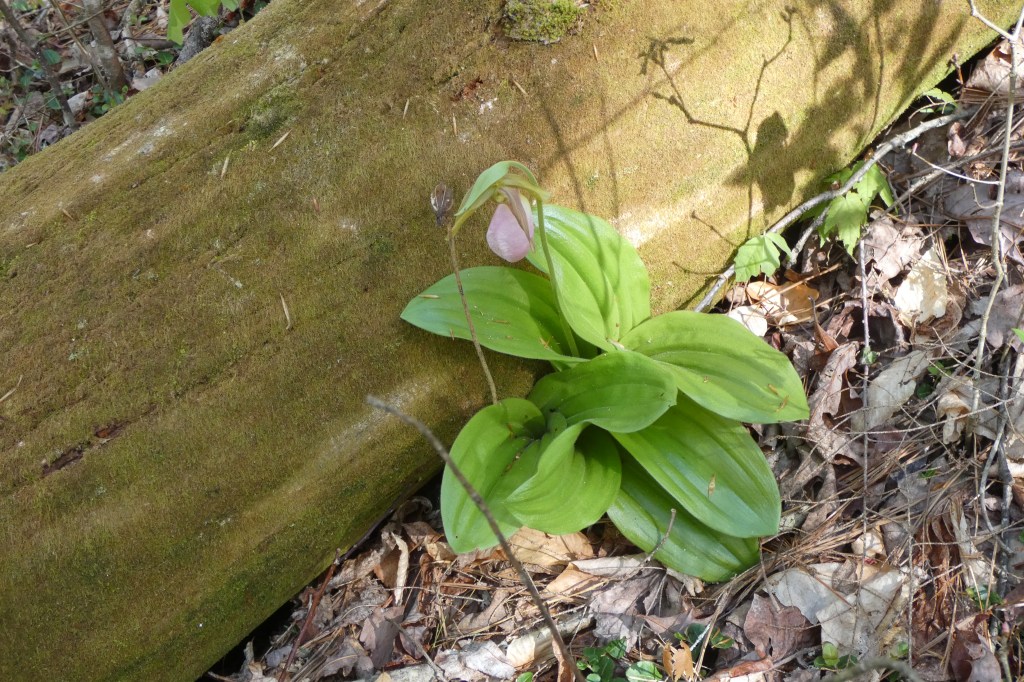
One of our favorite adventures is wild flower hunting in the Great Smoky Mountain National Park. We use to try to go every other year. We have gotten away from that practice. We decided to return this spring and test ourselves to see if we are still able to hike the trails where we have found our favorite flowers, especially Lady’s Slippers.
Lady’s Slippers are wild orchids and are quite rare. We learned not to tell others where we find the flowers. They need a specialized environment to grow. Some folks try to pick them. They do not thrive. Some folks try to dig them up and take them home. You cannot duplicate their environment. They even require a certain kind of fungus to grow.
In order to survive and reproduce, pink lady’s slipper interacts with a fungus in the soil from the Rhizoctonia genus. Generally, orchid seeds do not have food supplies inside them like most other kinds of seeds. Pink lady’s slipper seeds require threads of the fungus to break open the seed and attach them to it. The fungus will pass on food and nutrients to the pink lady’s slipper seed. When the lady’s slipper plant is older and producing most of its own nutrients, the fungus will extract nutrients from the orchid roots. This mutually beneficial relationship between the orchid and the fungus is known as “symbiosis” and is typical of almost all orchid species.
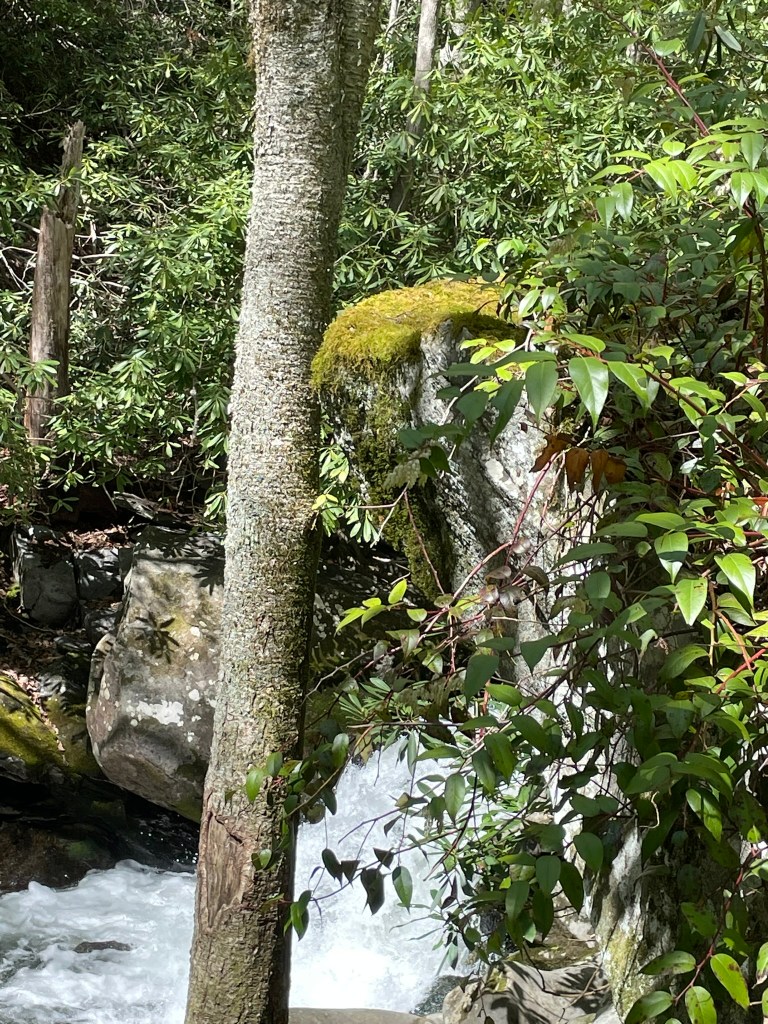
We hiked our first test, The Townsend trail called Middle Prong of Little River. We did not find the Jack-in-the-pulpit. One of my favorites. With global warming it is difficult to know when we should travel there. The “Jacks” along this trail had already bloomed and wilted. The waterfalls, however, were running gloriously. The rushing water always reminds me of the ‘streams of living water’ promised in the New Testament.
37 On the last day of the feast, the great day, Jesus stood up and cried out, “If anyone thirsts, let him come to me and drink. 38 Whoever believes in me, as[a] the Scripture has said, ‘Out of his heart will flow rivers of living water.’” 39 Now this he said about the Spirit, whom those who believed in him were to receive, for as yet the Spirit had not been given, because Jesus was not yet glorified. John 7:37-39
Along the trail we did see Showy Orchis. It too is part of the orchid family. The ones below are fairly bleached out indicating they are older blooms.
If you notice the fly on the leaf you can estimate the size of the flowers!
Here we are, not pros at selfies, but delighted to have made it up our first trail!
Waterfall between us!
We checked into our motel and rested towards our BIG hike. It was amazing how things looked so different. A couple of years of absence, a few wind storms and bunches of fallen trees – we at times had difficulty recognizing the next trail.
Unheard of for me to hike 5.11 miles. My shoulder definitely felt it that evening.
My phone told me about my activity level. It was very high activity level for me. There was some difficulty from pain on the way back to the car. Phone did not record flights climbed, but the altitude did change throughout the morning.
One phenomenon I never tire of is the swallowtails and other butterflies sipping minerals from horse apples.
photo by Molly Lin
photo by r m dutina – notice all the wing movement he caught!
photo by r m dutina THIS is why we hiked so hard!
and these hidden on the hillside, but not from us! photo by r m dutina
Yep, old folks hiking and spotting and then, not exactly scampering, but getting up the hillside for a better shot! The horses are not allowed on this part of the trail, but old people are!
photo by r m dutinaphoto by r m dutina – While up there he saw her, too!
We hope and pray this was not our last time on this trail, but if we cannot make it the next time we visit, at least for this one day we were totally satisfied! the hike back to the car is all down hill and takes a toll on your knees, not to mention your back. We made it! Only had to rest a few times and rest is okay. One friend gave me a sticker that says “It doesn’t matter how slow you go, as long as you don’t stop!“I just imagine if these are the lady’s slippers we know about, how many more are hidden on this part of the earth! The Lord certainly delights us with beauty.
But ask the animals, and they will instruct you; ask the birds of the sky, and they will tell you. 8 Or speak to the earth, and it will instruct you; let the fish of the sea inform you. 9 Which of all these does not know that the hand of the Lord has done this? 10 The life of every living thing is in his hand, as well as the breath of all humanity. Job 12:7-10 CSB
Life meanders like a path through the woods. We have seasons when we flourish and seasons when the leaves fall from us, revealing our bare bones. Given time, they grow again.
KATHERINE MAY
During my formative years my parents always kept a dog. Four years ago Bob and I adopted a small beagle from a rescue shelter. She was very, very timid. The shelter had brought her from the wilds of Kentucky. They believed she had run away from a breeder. When they spayed her somehow the vet knew she had delivered two sets of puppies. They also had to pull many of her teeth. It is believed she had chewed her way out of a metal cage that the locals there called a coop. She broke off many of her teeth doing that.
We brought her home and did our best to get her settled. We gave her toys and she had no clue what to do with them. We would roll a ball and she would watch it as if to say, “So?” Eventually she relaxed in our company.
She thoroughly enjoyed her first pup cup of Starbucks whipped cream!
She learned how to help Bob drive.
About 4 months after we adopted her she was attacked by a pit bull in the neighborhood. We rushed her to the vet for an emergency Sunday visit. It was my birthday. She had head trauma, puncture wounds and soft tissue injuries. It was terribly frightening. She recovered and so did we. Bob followed through on getting that dog out of the neighborhood.
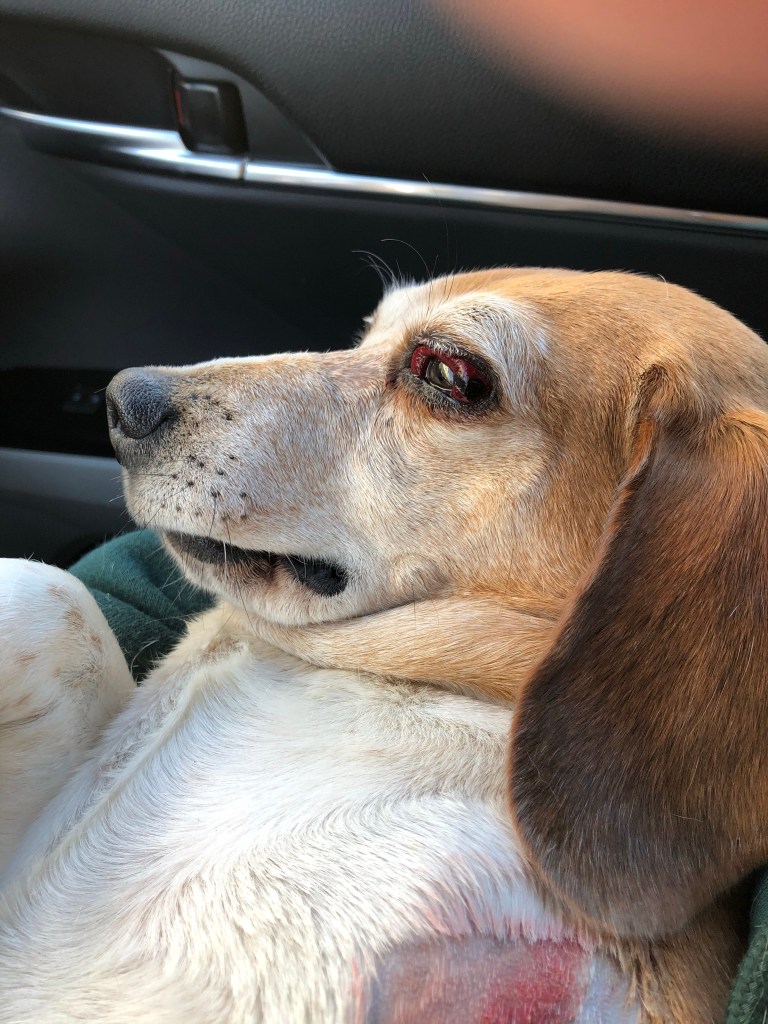
after her vet treatment
When we moved from Siesta drive to Platform street, she really came into her own. She began to think that yes, everyone could be a friend. She was convinced that certainly those visiting our house came to see just her.
Time rolled by. We loved her dearly and she in turn began to show a little affection for us. She has only barked a few times over the years, usually going many many months in between episodes. Even as a beagle she never bays or howls.
Best place to be if a thunderstorm occurs!
She is like my silent companion until we put her on a leash. Then she becomes the nose on legs. She has grown front shoulders like a football player and can hold her place while she reads her “pee-mail.”
About a year ago she began to show some pain in one back leg. Then it subsided and we thought no more about it. We did get her canine glucosamine chondroitin tablets. We bought a new couch and put a fabric cover on it. Her favorite place has always been lying on the couch and we allow that. She asks for so little.
I’ve taken to calling her “Beagley-beag.” She is also known as Luck-Luck and a variety of other terms of endearment. I talk to her throughout the day. If we have been gone from the house a few hours she greets us with little whines as if to ask, “Where have you been?” If we had reason to kennel her while we were away she comes out of her crate giving us a piece of her mind. It sounds like, “How dare you? Don’t you know I will be good?” She knows how to bawl us out without a single bark.
When I had shoulder surgery in January she would sometimes want to get up on the couch and had difficulty doing it. She would even cry for me to pick her up but I was unable to lift her while wearing the sling for 6 weeks. I made her a pillow bed on the floor. Occasionally she would screw up her courage and jump up on the couch. That became more and more rare.
She needed a bordetella injection and I was concerned about her refusal to jump up, so I took her to a new vet in March as the other vet had stopped offering boarding and gone corporate. The new vet put her on two medications for her leg pain and asked that she come in for more blood work before they would refill the one Rx. They wanted x-rays of her legs. We refused the x-rays as we do not plan to submit her to surgery.
When we went to the Smoky Mountains in April we boarded her with our granddaughter who likely takes more indulgent care of her than we do! We were shocked when we returned after 4 days. She had declined drastically. She could barely walk. When she did walk she held her tail with a strange bend in it as if trying to improve her balance. Whereas in the past this dog always had to be on a leash or she would take off, now we could drop the leash in the yard and she would not move. A couple times I took her out to “do her business” and she would just lie down. Bob used to walk her about a mile every morning. Now she can barely make it three doors down the street and back.
I began to grieve sensing that her time on earth without suffering had passed. I know, I have messed up this blog with past tense and present tenses all intermingled. Suffice it to say it is just simply difficult to write this out.
We decided to return to the vet that we had left. They have treated her the entire time she has been in our care. They agreed that she is definitely suffering. They offered a monthly injection for osteoarthritis (which the other vet had offered, too). We decided to try it for one or two months to see it is improves her particular condition. The vet says the problem seems to be in her back “knees.” We are weaning her off one medication. Once that is out of her system they might try a steroid medication if she still has not improved from the injection.
The quote at the top of this blog set me off on this telling. Here are a few of the bare bones of my grieving. I never mean to get attached to our pets, yet I do and I love them freely. I have a better understanding now of why farmers say they do not want animals in the house. Once you name them, and house them, and live day-to-day with them it is that much harder to let them go when the time comes.
One neighbor said she wished her 12 year old Corgi could just out live her. Too hard to let go. Another said it is not fair that they die while in our care. I do not want to embrace the alternative of not having a pet. Bob has stressed repeatedly how difficult it is at our ages (read 70’s) to walk and care for a pet. This particular beagle refused to just go outside and “do her business.” She insists on being walked. So there is the conundrum of what to do when she passes. Bob said I can have another dog I really want one. I know if we get another it would need to be half of Lucky’s weight. At 27 pounds she is just too heavy for me to carry.
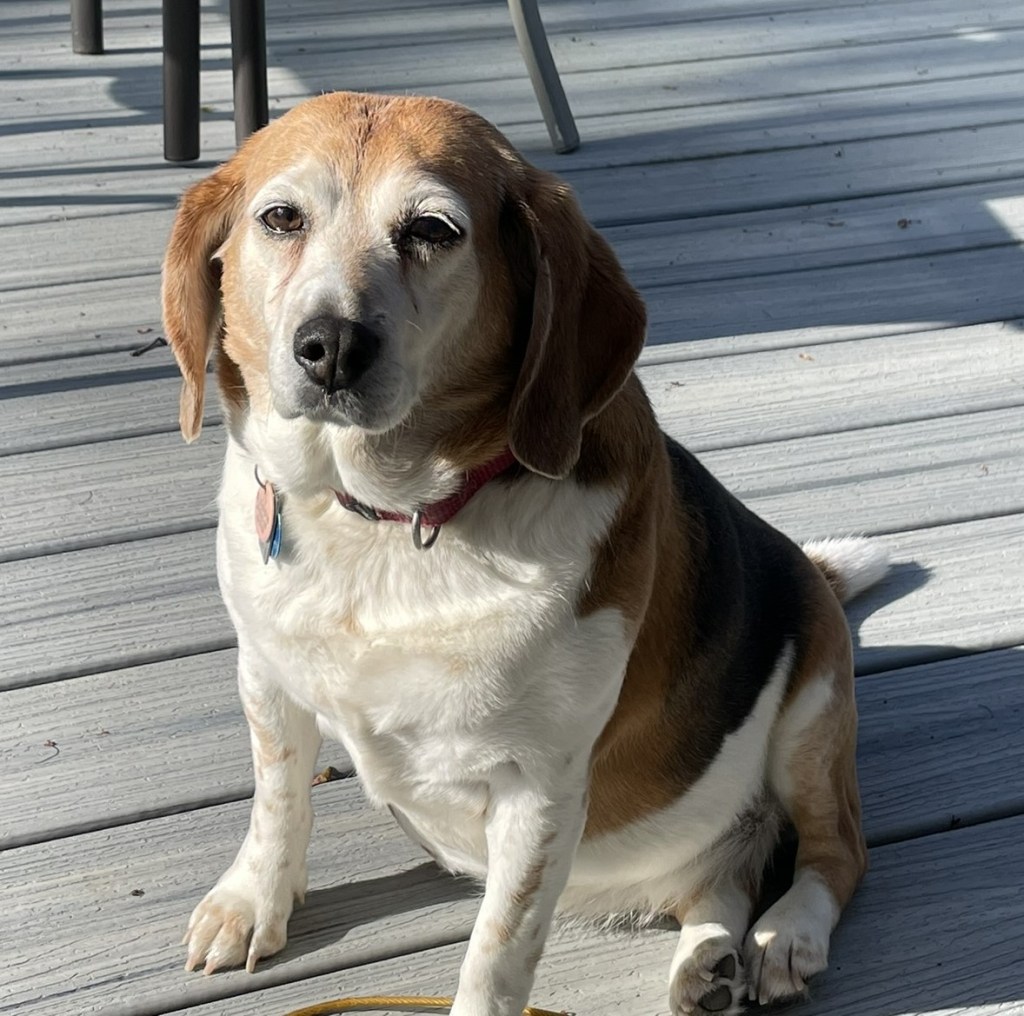
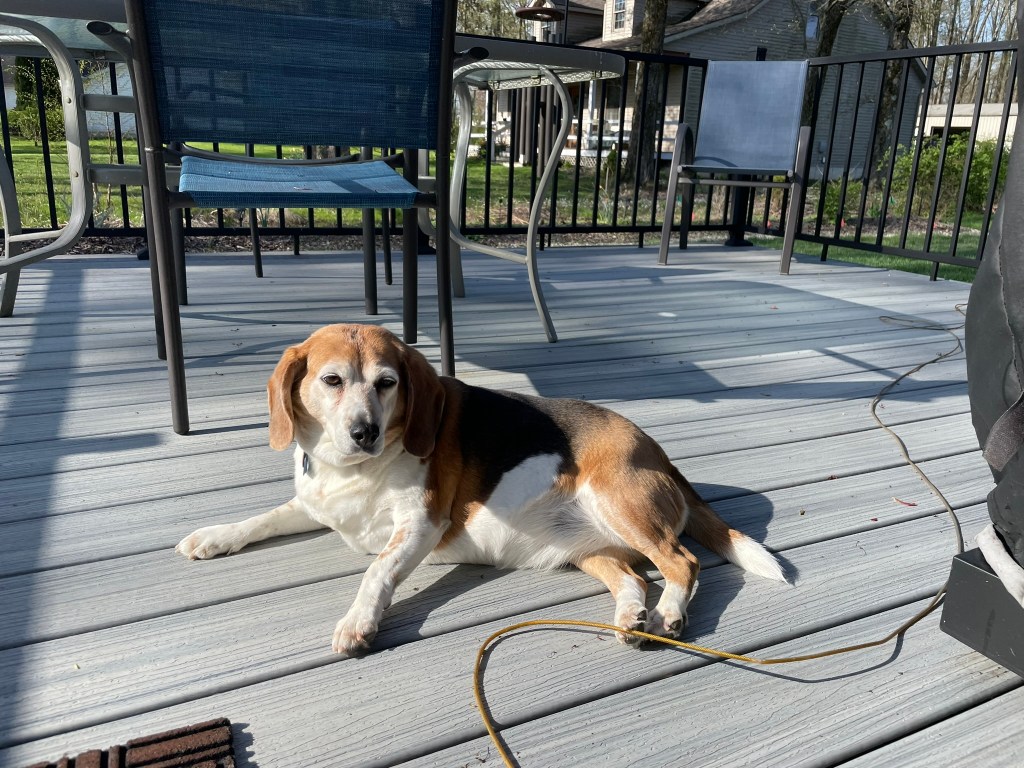
April 2024 sunbathing on the back deck and favoring that one leg though both now pain her
Recently the Lord reminded me that Lucky is on loan to us. I will try my best to trust the Holy One with her future. I am praying for grace and strength to release her peacefully when it is time. Watching her suffer is so very difficult.
A righteous man has kind regard for the life of his animal, But even the compassion of the wicked is cruel.
I did not post much last week because we were a way from home. First I went to the Associates Spring Retreat at the Convent of the Transfiguration where I have been an Associate since 1991. After that I came home on Sunday afternoon, emptied parts of my suitcase into another larger suitcase. On Monday morning we departed for the Great Smoky Mountain National Park to hunt for our favorite wildflowers. It seems like whirlwind now, but it was all loads of fun.
The retreat was led by a man named Kelly Latimore. He has a degree in art and religious studies. Since 2011 he has been painting or as the iconographers say ‘reading’ icons. If you have participated in Lectio Divina, (divine reading of Scripture) you will be able to relate to what he asked us to do. He called it “Visio Divina,” (divine seeing of the icons). It was a fascinating experience. There were about 15 of us in person at the retreat and another group joined us via Zoom.
Kelly would show us a slide of an icon on a large screen. We would begin to share what we saw in the icon. He educated us in the history of making icons and shared the vision for his art.
“However, I do not wish to approach Iconography as an art form that simply follows an inherited tradition, knowledge and practice. I want it to be a creative process, meditation, and practice that brings about new self knowledge for the viewer and myself. Who are the saints that are among us here and now? I feel the need for new images. In some icons I wish to embrace the traditional forms and image but for many icons the image needs re-shaping, re-imagining, and re-wondering.” https://kelly-latimore.pixels.com/
Christ the Light
Mary Magdalene and Christ the Gardener
If you go to his website you can follow the progression of his paintings and icons. There you will see how his talent has grown.
If you have never before used an icon for prayer, here are some pointers from online.
Praying with icons is a contemplative practice wherein we slow down to pray and pay attention to God. This may be done in silence, by talking to God casually, or by using hymns and other ancient prayers. Or even in combination of all three. If you are just getting started in praying with icons, I suggest starting by working on your attentiveness to the image.
Look at your icon. What is the first thing you notice about the image? Where are your eyes drawn? What colours are attracting your attention?
After you have taken in the image, you can start to think about the details. Are the eyes of Christ or the Saint looking at you, or elsewhere? If Christ is looking at you, spend some time gazing back into his eyes. I find this is an especially good practice when I’m working on listening to God.
What other symbols are in the image? Do you know what they mean? What does looking at the icon make you feel right now. What is the icon saying to you?
The retreat was so interesting! Sharing what we each saw or sensed was particularly enriching. Hearing Kelly’s reasoning for how he did the various paintings was educational and nothing I would have understood on my own.
He has paintings in the National Cathedral and many churches throughout the United States. There will be an exhibit at St Paul’s Episcopal Church, Cary, North Carolina on May 4 from 1-7 PM as follows:
“Join us as we welcome acclaimed artist Kelly Latimore to Cary for a show featuring his vibrant and thought-provoking icons. Kelly’s work has appeared nationally in places like the Washington National Cathedral and was selected as the cover of a Pope Francis book of sermons. We will have 25 of his pieces on display throughout the interior of the church on Saturday, with doors open to the public from 1-7 pm. Children are welcome, and Kelly will be here during the exhibition. There will be a panel discussion starting at 4:30 pm, which will feature the artist and guests from the Pauli Murray Center for History and Social Justice and the Episcopal Farmworker Ministry. The day ends with an artist’s reception at 5:30 pm, and we’re asking folks to RSVP so we can plan accordingly. This is a day to celebrate Kelly’s art and vision, to see others in a new way, and to offer something to the community. There is no charge for the exhibit, but we do encourage donations.”
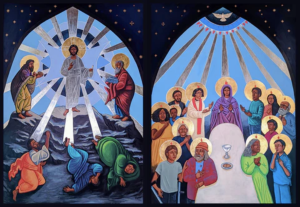
If you click the link above you can see his icon of the Transfiguration and Pentecost. He said when they were designing the Transfiguration the congregation did not want Christ in all white clothing. They decided to add silver leaf to the painting. When it was hung in the sanctuary he was amazed at how the light in the sanctuary made the icon flash and dazzled his eyes, like the actual transfiguration. I want to go to Salisbury to see that painting/icon! ROAD TRIP!!!
The mower teams are here and their machines are quite loud. Most every Monday or Tuesday morning they arrive while I am writing entries for the blog. Today is very warm so one of my office windows is wide open.
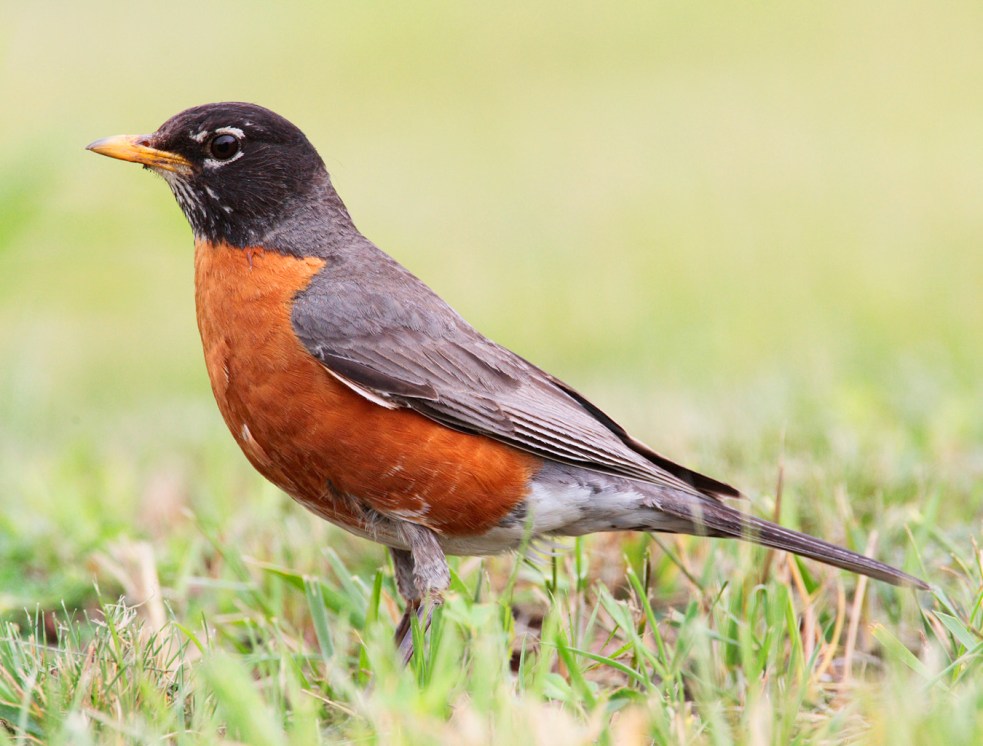
As the mowers moved into the distance I drew a deep breath of relief that the noise had lessened. Suddenly I was startled by a loud sound. Evidently a Robin had landed in the garden mulch below the window and began to sing. I about jumped out of my skin!
When close to your ear this one can be startling!
The tulip bulbs have been decimated by the rabbits – again. I put up spinners and wooden stakes, fence pieces and even aluminum pie pans that mom swore by. I finally told my grandson when he was due to come help in the garden with his dad that he should dig up all the tulip bulbs. Before the family could get here those pesky rabbits ate all the stems and leaves. Guess I will dig them up next year when they first emerge!
Ah the joys of nature! They do not conform to our wishes. And yes, we are still blowing maple seeds off the back deck and front walkway 😉
To the Lord your God belong the heavens, even the highest heavens, the earth and everything in it. Deuteronomy 10:14 NIV
Yep! The birds, the tulips, the rabbits, the maple seeds, the mower men and everything under the sun! Even you and me.
We are preparing for a blizzard here in Ohio. The pink blooms were lovely while they lasted.
Now the spring winds are bringing us a blizzard. A blizzard of pink and yellow maple seeds. Nature wants to be certain there are forever maple trees growing and spreading in Ohio. Thus the blizzard. A few have fallen already. The wind makes it sound like there are dry leaves out our door. Have you listened for that sound?
They are not leaves. Just hundred of thousands of seeds. Perhaps even millions fill the sky with whirligigs. Bob used the blower on the back deck to clear off the seeds. The next day he looked out the window and said, “I just blew those off!” I smiled and answered, “Not those particular helicopters.”
The flowerbeds will soon be sprouting these seeds. If the landscapers put down mulch before these are removed there will be an ideal sprouting medium for those seeds. I am still pulling out seedlings from last year’s blizzard!
Ah, but I would not give up living with my beloved maple trees. I was worried about the survival of two trees in the neighbor’s yard as they seemed to bloom really late. I had begun to wonder if those two trees were dying. They are in bloom now.
The shade they offer is so welcome. When the leaves turn colors in autumn I am delighted. Each year I try to video when the trees “drop their gowns.”
So this is not a blizzard we can shovel or combat with rock salt. In a couple weeks I will be removing handfuls of maple seeds from the flower beds. If I plant annuals I will be removing more sprouts and seeds.
Bring it on God! I have no control over this phenomenon, so I might as well find joy in it!
I signed up a long time ago for a newsletter from Joan Chittister. I so enjoy her writing! This one arrived recently in my email box and I thought you might enjoy her ideas. Here is a portion of the article. I have added a link at the end in case you want to read the entire article It is taken from her book The Monastic Heart.
What You Pay Attention to in Life
“Every afternoon, as I sit in my upstairs office, I hear the old monastery bells begin to ring in the once Benedictine church that then adjoined this inner-city monastery. In fact, the bells from Benedictine monasteries everywhere still peal out around the world. Our original monastery moved over 50 years ago from an in-town property to the edge of the city. So, we have another bell tower and a new electronic carillon. The big old brass bell, “Theodore,” shipped from Germany ages ago, now rests retired and reverenced on a brick base in the memorial garden of the new monastery. New bells go on ringing over our lakeside property daily, just as the old one did here in the inner city for more than 150 years. No bedroom clocks, no personal watches take their place as harbingers of spiritual time.
“But why?
“The purpose of Benedictine bells is not to spell out the hour of the day at all; that task is left to horologists. Our bells, on the other hand, are there to wrench our attention back to what is really important in life: the memory of God in our midst. The memory of the purpose of life. The memory that time is moving on and so must we. The recognition that life today is different than yesterday, and we must not try to hold life back. The bells jog the memory that there are actually more important, more meaningful, more demanding dimensions of life than anything ordinary we can possibly be doing as they ring.”
The bells are there to “wrench our attention back to what is really important in life: the memory of God in our midst.” I occasionally hear the bells from the Catholic church that is several blocks away and through the woods. When I notice them I stop to breathe deeply and pray. I more often hear the sirens going down the busy highway two blocks away. I have made it a habit to pray for the police, EMS and fire people responding to their various emergencies. I like Joan’s idea of ‘wrenching our attention back to what is really important in life.‘ I think I will continue to pray for the emergency workers but also pause to ask myself if I am remembering God in our midst whenever I hear the sirens.
What reminds you of the presence of God in your midst? We have two clocks that chime. A Cuckoo clock that was a gift from friends who traveled to Germany and my parents mantel clock that was a gift for their wedding in 1934, almost 90 years ago, and it still runs. At times, living with the clocks, I do not even hear them ring. Bob says they draw him back to what is really important.
What serves to wrench your attention back to God? Years ago when I taught Bible study I would encourage the students to find something they do daily. Then prayerfully dedicate that to the awareness of God. As a daily practice begins to build, the awareness of the Holy One becomes easier and easier. I used to dislike bracelets. I would wear one so that each time I was bothered or irritated by the bracelet I was reminded to turn my attention to God.
Sirens? Church bells? Bracelet? Huge water bottle you drink from all day? In this day and age it would be fairly simple to set your smart watch to ring once an hour as a reminder to pay attention to the Trinity in your midst. To stop and breathe, returning ‘back to what is really important in life.’
“The bells jog the memory that there are actually more important, more meaningful, more demanding dimensions of life than anything ordinary we can possibly be doing as they ring.”
The Verdin Bell Company is anchored in the Cincinnati area. They have made, installed and restored church bells for years. Perhaps this photo will encourage you to restore your attention to the Holy One?
Seven times a day I praise You, Because of Your righteous judgments.
My friend, Debbie, told me about a free app called “Merlin.” https://merlin.allaboutbirds.org/ Cornell labs developed it and I just love it! Pictured below is how the screen looks for Merlin.
Years ago Bob and I went on a birding adventure with the Cincinnati Nature Center in the Lake Erie area. We were surrounded on a boardwalk by people from many areas. The birds were mostly high in the treetops. Even with binoculars I was unable to see most of them. The birdsong was glorious! I was very humbled when the Amish children walking with us were able to identify the birds by their song. Yes I live in an industrialized society. Sadly most of us lost touch with that sort of skill. I was taught to identify some spring wildflowers but never to identify bird song. Bob and I were not shamed as much as amazed at the abilities of those children!
Shout for joy to God, all the earth! 2 Sing the glory of his name; make his praise glorious. 3 Say to God, “How awesome are your deeds! So great is your power that your enemies cringe before you. 4 All the earth bows down to you; they sing praise to you, they sing the praises of your name.”
Psalm 66:1-4 NIV
I have my morning prayer and meditation in my bedroom next to a south facing window. One recent morning the serenade was amazing. There were so many birds that I asked the Merlin App to identify who was singing. Twelve different birds! What a wonder and a blessing. Here is the list the app created:
Carolina Wren
Northern Cardinal
House Finch
Tufted Titmouse
American Robin
Song Sparrow
Blue Jay
Brown-headed Cowbird
Canada Goose
Carolina Chickadee
White-throated Sparrow
Red-winged Blackbird
Along with the bird names that were linked with the songs there were photos. I could click on any one of them and get more details.
I know there are many folks who do not like modern technology. I am not saying that all of it is unequivocally good. But to me, this one app is absolutely amazing! Sparrows abound in our neck of the state. So did I see the one pictured above or this one?
So many sparrows, so little time. Will I ever learn to identify all of them by sight? If not, I have Merlin to aid me.
Are not five sparrows sold for two pennies? Yet not one of them is forgotten by God. 7 Indeed, the very hairs of your head are all numbered. Don’t be afraid; you are worth more than many sparrows.
Luke 12:6-7 NIV
The April 15 New Yorker just arrived. Here is the cover artwork!
As the weather warms as it has the past couple of days, Lucky the beagle loves nothing better than to lie on the deck and bake her bones in the sun. The other day I opened the screen door to let her in.
Zoom a bee came in with her.” “Oh crap,” I exclaimed. the bee headed for the stereo cabinet. I turned to grab a couple of tissues, (the closest thing at hand). When I turned back it had gone inside the cabinet. Opened the door and it was headed for a plastic storage bin. I knew I had to act fast or I might never catch it.
Do you remember the childhood song, “I caught a little baby bumble bee, won’t my mommy be so proud of me!”
Unbelievably, using the tissues I swiped at it hoping to keep it from the cabinet. Surprisingly I knocked it right into the dog’s water bowl! Bee was swimming and rather frantic.
As an adult I have never been one to kill a bee intentionally unless there is no other way to avoid getting a sting. I went to the silverware drawer and got a tablespoon. Scooped up the bee. Put the tissues over it. Took it outside, not knowing if it would survive its unwanted bath.
It flew away. I have since tried to look around the screen before opening it for the dog. Yesterday there was a sting bug crawling on the screen. Summer must be just around the corner!
Gracious words are a honeycomb, sweet to the soul and healing to the bones.
Proverbs 16:24
Lucky is aging.
The speech below was recorded 13 years ago. The need right now is even more urgent today. Even if you only watch 3 minutes of this I think you will enjoy it!
We experienced some darkening of the sun during the 2017 total eclipse. This year the area around us went totally nuts!
Were you caught up in the total solar eclipse mania? We live just on the edge of totality. (Sounds like a title for another posting doesn’t it!)
Sonic offered blackout slushy drinks. Busken’s Bakery had eclipse cookies. Hotels and motels were fully booked months in advance with rates 3-4 times the usual price. All the Air B & B’s and similar places were sold out in the areas of totality. Four minutes of wonder and splendor in the sky and not only America went nuts, but people came to the path of totality from all over the world.
The Ohio Governor was constantly warning about using safety glasses to view the eclipse. It was stated in every news cast. The library carried free paper viewing glasses. The grocery store and the drug stores sold them. The warnings were so strong that it made me wonder how many new patients Cincinnati Eye Institute would be seeing on that day or the next?
1 In the beginning God created the heaven and the earth.
2And the earth was without form, and void; and darkness was upon the face of the deep. And the Spirit of God moved upon the face of the waters.
3And God said, Let there be light: and there was light.
4And God saw the light, that it was good: and God divided the light from the darkness.
Genesis 1:1-4 NRSV
It would have been wonderful if God had used the occasion to speak to the earth, much like the coordinated music for fireworks displays! Oh Father, forgive us for not remembering that You created and planned all of this.
The radio story tellers were reminding us days in advance how many ancient people tracked each eclipse, kept records and could eventually predict an eclipse. They reminded us of how folks had fear beliefs such as “the King of our country will die this year because of the eclipse.” Such unusual events in the heavens caused fear and trembling. Sadly, in our day and age, the eclipse caused more amusement than wonder at the mighty creativity of God. We have been warned and warned not to look at the sun without eye protection or risk burning holes in the retinas of our eyes.
I have to wonder that not being in amazement of God’s creation risks burning holes in our heart and mind? He is a wonder working God! I mean, come on! You must admit that you would never be able to pull off a total solar eclipse!
More recently, Anne Graham Lotz, daughter of iconic evangelist Billy Graham, has seen speculation among some that the combined paths over the United States of this year’s eclipse and the previous two solar eclipses appear to mimic the shapes of the first and last letters of the Hebrew alphabet — in other words, the beginning and the end.
“Maybe people are reading too much into it,” she told USAToday recently. “But when you look at the world, you don’t need an eclipse to know that things are getting really dangerous. Maybe it’s telling us it’s time to get right with God and the people in our lives, so that we have no regrets.”
I give thanks to God for this event, Creator of the heavens and the earth, King of my heart, Lord of the Universe. All glory to You, Lord Christ. Amen.
The bluebells seemed to have died. Then this spring they jumped up in splendid life! The first flower formed and I was delighted. A couple days later the flower had been eaten. Another flower formed and I hoped the first tasted nasty and no one would return to eat this one. Well, either it tasted good or another garden visitor took a taste because that flower is gone now, too!
Remember my disappointment that the bulbs I planted came up as crocuses? Well, I was SO WRONG! Seems I planted the chionodoxa bulbs on top of crocus bulbs, (so hard to remember where everything is underground in November). After the crocus, the Chionodoxa bloomed and they are lovely!
In autumn the trees delight me with multicolored leaves. This spring seems especially nice as the treetops are “laced” with blooms of various colors.
The sad news is the beagle, Lucky, seems to get more lame. The vet wants to do x-rays and blood work which last week cost $90. She says the last medication made her liver values worse. We are uncertain exactly how old she is, 7 or more years? We do not want her to be in pain, but we also do not treat our animals as if they were human in terms of medical care.
We took her to the woods with us for a romp. After a little bit, I was afraid we might need to carry her back to the car. She could not jump over small fallen branches and trees as in the past. She was obviously suffering. Oh my heart misses her already. She is my companion and has her quirks as she is a rescue, but what to do for her? Yellow lace, red lace, so much joy!
Walking in the woods I found little yellow bud covers / cases and wondered what they were from? Then a few more steps and I found this broken branch.
There was not a naturalist in the State Park office, but the women working there took a photo and sent it to one. Later that day I got an email stating this is a male Eastern Cottonwood! I was amazed. I used to wait for a ride to high school under a cottonwood tree and never once saw this! We have walked under cottonwoods in New Mexico, too.
For everything there is a season, and a time for every]purpose under heaven: 2 a time to be born, and a time to die; a time to plant, and a time to pluck up that which is planted; 3 a time to kill, and a time to heal; a time to break down, and a time to build up; 4 a time to weep, and a time to laugh; a time to mourn, and a time to dance; 5 a time to cast away stones, and a time to gather stones together; a time to embrace, and a time to refrain from embracing; 6 a time to seek, and a time to lose; a time to keep, and a time to cast away; 7 a time to rend, and a time to sew; a time to keep silence, and a time to speak; 8 a time to love, and a time to hate; a time for war, and a time for peace.
















 Treasures in Plain Sight, A Christian Blog