When the tree first arrived to our property I made a point of picking off the galls that were attached to the leaves. We have fed this tree and watered it. The soil here is difficult for anything to grow in. The builders did not help by mixing in huge rocks! In spite of the odds the tree is beginning to thrive! I was thrilled when I realized (once again) that this is a Burr Oak tree.
In 2002, long before we lived here, I wrote a piece about the inspiration I gained from a Bur Oak acorn. I will post it over 2 days, giving you time to ponder the message and trying not to bore you with a LONG read!
Often while I am walking prayerfully, my attention will be drawn to something around me. I will pick up the object and continue on my prayer walk. So it was during the mild February of 2002 while I was on retreat and came across a Bur Oak acorn. As I held it in my hand, continuing my walk and praying, I knew it would unfold its mysteries to me in the days or months to come. As I left the retreat grounds, I placed the acorn on the console of my car. For many months it rode right next to me with this scripture ringing out from it’s hard, pointy cover:
“Enlarge the site of your tent and let the curtains of your habitations be stretched out; do not hold back; lengthen your cords and strengthen your stakes.” Isaiah 54:2 NRSV
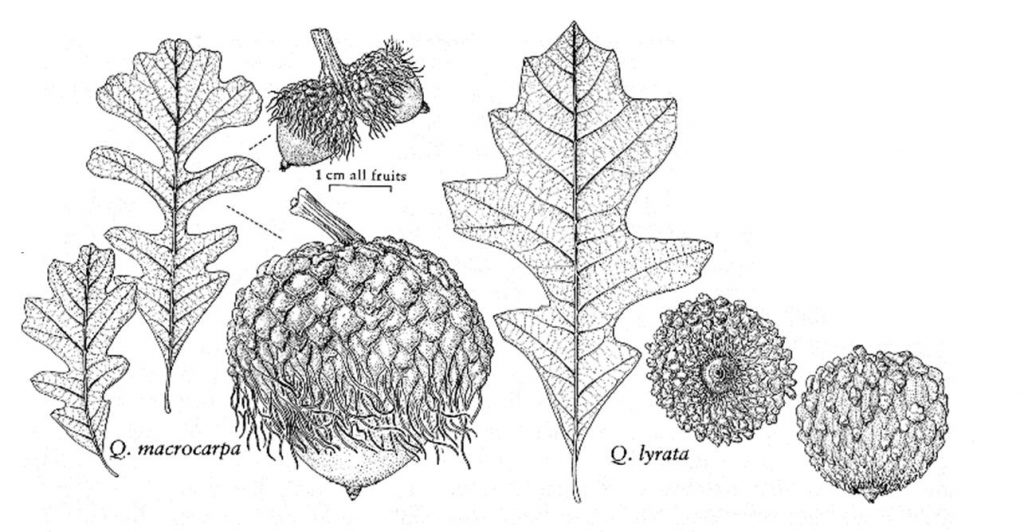
If you are not familiar with the Bur Oak (also at times spelled Burr oak) here is a short history taken from various Internet resources. The tree is tall, fairly slow growing, long-lived, and highly desirable for windbreaks, shelterbelts, and ornamental use. It has an impressive crown with a massive trunk and stout branches. The bur oak adapts to various soils where other oaks fail. The tree is tolerant of urban conditions. The bur will bear acorns in the nursery in ten years. It has strong wood and is good for timber.
The acorn itself is classified as a nut, because of its bony pericarp, and is actually the fruit of the oak tree. Particular to the genus Quercus, the stem broadens to the cupule or cap that holds the oak seed and fruit in place. The burr oak, so named because of its characteristic large seeds or acorns, was known as u’tahu can in the Native American tongue of the Lakota people, meaning acorn stem tree. More than half of the one-inch acorn is enclosed in a fringed, spiny cupule. Native Americans used them as an important dietary item with great storage capability and mobility. Wildlife, including turkeys, blue jays, squirrels, and deer also utilize acorns as a food source that is rich in carbohydrates and fats.
Today we like Bur Oaks for their adaptability to urban conditions. Indians and animals used them for food. What did God want me to see? I see an acorn with an almost impenetrable cover. Hard and dried and in it’s own way thorny. After months of looking at this Bur acorn, I began to realize that this acorn could be me. I could have my fruit “nearly completely covered by a rough, frilled cap.” Though I may ripen “in early to mid-autumn” the fruit would be unpalatable and inaccessible unless I let others have access to the fruit God has given to me.
There are at least two ways we can view the acorn: as a nut/fruit to eat or as a seed to plant. Animals unwittingly spread the Bur oak trees by burying stashes of the nuts and then forgetting where they put them. These nut-seeds may germinate into new oak trees. Therefore, I have choices here! I can remain one tough acorn, almost completely covered with a hard facade, or I can risk opening and revealing what is within. Paul made the same challenge to the Corinthians.
We have spoken frankly to you Corinthians; our heart is wide open to you.There is no restriction in our affections, but only in yours. In return–I speak as to children–open wide your hearts also. 2 Corinthians 6:11-13 NRSV
Moreover, the Living Bible makes it a bit clearer:
Oh, my dear Corinthian friends! I have told you all my feelings; I love you with all my heart. Any coldness still between us is not because of any lack of love on my part, but because your love is too small and does not reach out to me and draw me in. I am talking to you now as if you truly were my very own children. Open your hearts to us! Return our love! 2 COR 6:11-13
My choice to open or remain closed to my Christian brothers and sisters around me is always my choice: daily, weekly, monthly.
The right choice was strongly recommended by our Lord in John 12. He is speaking here about a grain of wheat. An acorn, as the seed is not a far stretch. Thinking of the nut-seed as buried in the ground read John 12.
“I am telling you the truth: If one grain of wheat does not fall into the ground and die, it will always be just one grain of wheat, but if the grain dies, it will produce a large cluster.” And in Simple English “Very truly, I tell you, unless a grain of wheat falls into the earth and dies, it remains just a single grain; but if it dies, it bears much fruit. Those who love their life lose it, and those who hate their life in this world will keep it for eternal life. “ John 12:24-25 NRSV
“Most assuredly, I say to you, unless a grain of wheat falls into the ground and dies, it remains alone; but if it dies, it produces much grain. He who loves his life will lose it, and he who hates his life in this world will keep it for eternal life.” John 12:24 New King James
It seems, through comparison of these three translations, that if I am to open to those around me I must fall into the ground, die to being just a nut seed, and live to becoming a tree plant. Truly a transfiguration! I may choose to remain just an acorn – alone – yet still an acorn. Alternatively, I may choose to move on to the next phase of living that God had in mind when He blew life into my being. Falling into the ground and dying will mean willingly removing my outer impenetrable cover, stripping away my surface persona to become the best that is within me. Hard and dried and in its own way thorny, the familiarity of the husk has become almost more desirable than the risk of the unknown I will face as a growing plant. The Gardener calls me on. (John 15:1)
Do we find this so surprising, that Jesus would ask us to die to our familiar ways and become something new with His help and guidance? Wasn’t He asked to die on our behalf and take on a new life form by our heavenly Father? Constantly, the Father left the task before Jesus as a choice. Jesus chose to become the firstborn from the dead. (Colossians 1:18) He leads the way for us.
Are you willing to yield yourself in surrender to His plans? Will you open wide your heart to His calling and the tasks God sets before you?


 Treasures in Plain Sight, A Christian Blog