
When we lived on Siesta Drive we had a pawpaw tree in the back yard. I never once saw fruit on it, but the unfolding leaves were dramatic!! Sadly I did not get a photo.
And yes, there are two acceptable spellings.
We were walking recently at the Cincinnati Nature Center. We took a trail we do not usually take. As we were wandering along I remembered there had recently been a guided walk showing participants native fruits. As we walked amidst the pawpaw trees, sadly I thought,”Huh, I have never ever seen a Pawpaw fruit in the wild.”

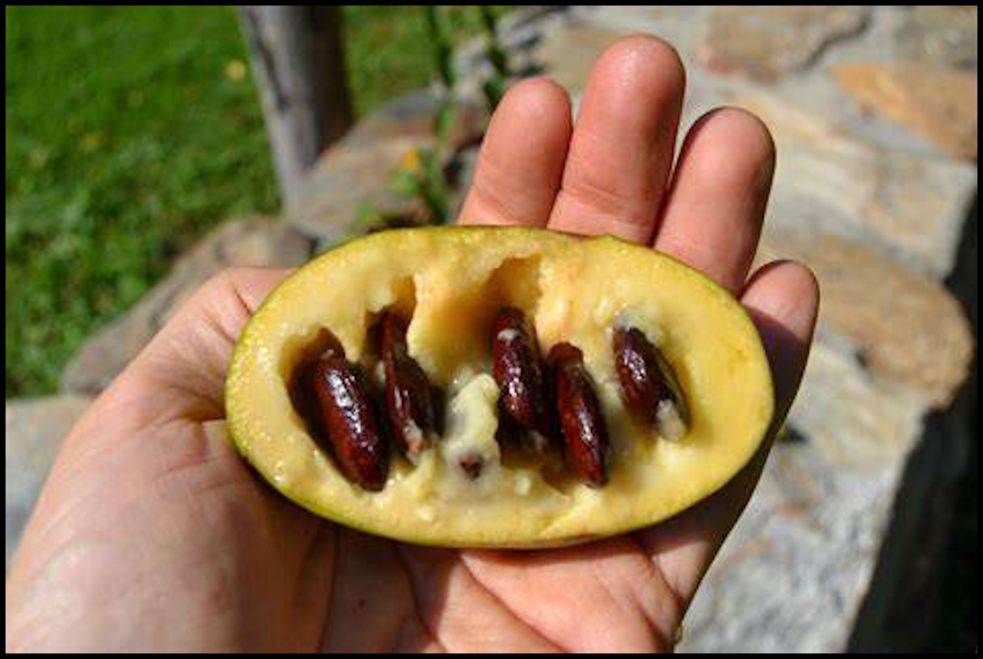
As Bob took various photos and the dog moseyed along sniffing the myriad scents along the trail, I noticed a rounded rock. “Hmm,” I thought,”the gravel here is rough not rounded.” I nudged it a bit with my toe, then I bent to pick it up. NOT a rock!! A pawpaw! And they really do smell like fresh bananas!
Bob captured this photo for me and for your enjoyment!

It really smelled delicious! I have had a queasy stomach so I could not bring myself to taste it, though I really wanted to! As the dog and I strolled along I carried it with us. Trying to take a photo of something else, I accidentally closed my hand over it. It had burst the skin. Yep! it was sticky. I put it on a log hoping someone else would delight to discover it. Of course, all of this lead me to look up its details when I got home!
The pawpaw plant can grow up to 12 metres (40 feet) tall and has pointed, broadly oblong, drooping leaves up to 30 cm (12 inches) long. The malodorous, purple, 5-cm (2-inch) flowers appear in spring before the leaves. The edible fruits are 8 to 18 cm (3 to 7 inches) long and resemble stubby bananas; the skin turns black as the fruit ripens. Depending on the variety, pawpaw fruits vary in size, time of ripening, and flavour.
Brittanica
The pawpaw is a patch-forming (clonal) understory tree found in well-drained, deep, fertile bottomland and hilly upland habitat, with large, simple leaves. Pawpaw fruits are the largest edible fruit indigenous to the United States. Pawpaw fruits have a sweet, custard-like flavor somewhat similar to banana, mango, and pineapple, and are commonly eaten raw, but are also used to make ice cream and baked desserts. The bark, leaves, and fruit contain the insecticidal neurotoxin, annonacin. Native Americans used the fiber of the pawpaw tree to weave ropes and nets.
Because of the lack of human propagation and the abandonment of much farmland in the Southeast during and after the Great Depression, pawpaws became extremely rare by the late 20th century, but are making a comeback. In fact, the State of Kentucky has established an experimental farm and agricultural labs in order to develop commercial varieties for international marketing. The Choctaw Nation of Oklahoma and the Catawba Nation of South Carolina and North Carolina have initiated major pawpaw cultivation and experimentation programs in order to encourage Native Americans to grow the delicious fruit.
https://apalacheresearch.com/2021/06/24/the-indigenous-agriculture-of-the-americas-pawpaw-fruit/
Could it be that in my lifetime Pawpaw fruit might hit my local market? Well, after getting a whiff of the fragrance I would encourage you to purchase and taste some if you come to it in the market!
Largest edible fruit indigenous to the United States! Wow!
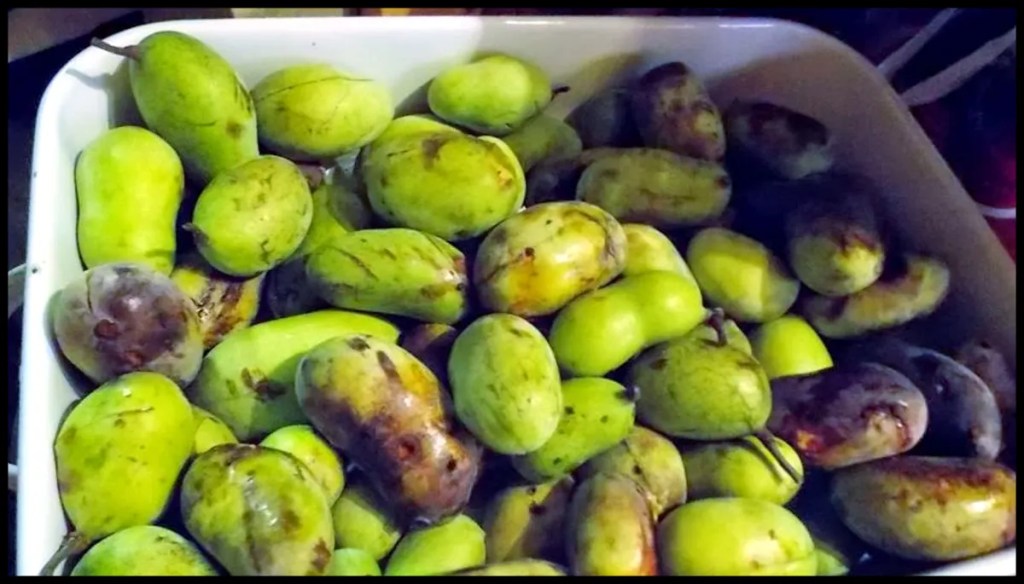
Keep your eyes open for those treasures in plain sight!! Never now what you might find!!
Now the Lord God had planted a garden in the east, in Eden; and there he put the man he had formed. 9 The Lord God made all kinds of trees grow out of the ground—trees that were pleasing to the eye and good for food. In the middle of the garden were the tree of life and the tree of the knowledge of good and evil.
Genesis 2:8-9 NIV
 Treasures in Plain Sight, A Christian Blog